China’s luxury bespoke lighting market is moving beyond visual extravagance. Clients now expect sculptural identity, precise craftsmanship, energy awareness, and seamless digital control. This raises a practical question: what are the trends in luxury bespoke lighting?
Industry data supports this shift. Grand View Research estimates that the global smart lighting market reached approximately USD 20.51 billion in 2022, with strong growth projected through 2030. Its findings suggest that connected controls, sensors, and adaptive illumination are becoming mainstream design tools. Fortune Business Insights also identifies decorative lighting as a growing global market, driven by premium interiors, hospitality projects, and residential renovation. These reports do not describe every Chinese buyer. However, they reveal the commercial direction surrounding bespoke products.
In China, luxury lighting is increasingly shaped by custom materials, oversized pendant forms, hand-finished metal, crystal detailing, and warmer layered illumination. Imagine a brushed-brass chandelier above a stone dining table, with concealed LEDs washing a textured wall. The fixture becomes architecture, not merely decoration. Craft still matters.
The ten trends explored in this guide connect global market signals with practical design experience. They include personalization, smart-home integration, sustainable components, artisanal production, and culturally informed forms. Yet the market is not perfectly predictable. Some “sustainable” claims remain vague, and technology can distract from poor proportion or uncomfortable glare. Data helps, but it cannot replace careful specification.
A reliable luxury lighting decision should consider photometric performance, material durability, maintenance access, color rendering, and installation safety. These details determine whether an expensive fixture remains beautiful after years of use. This overview therefore treats bespoke lighting as both an emotional purchase and a technical investment.
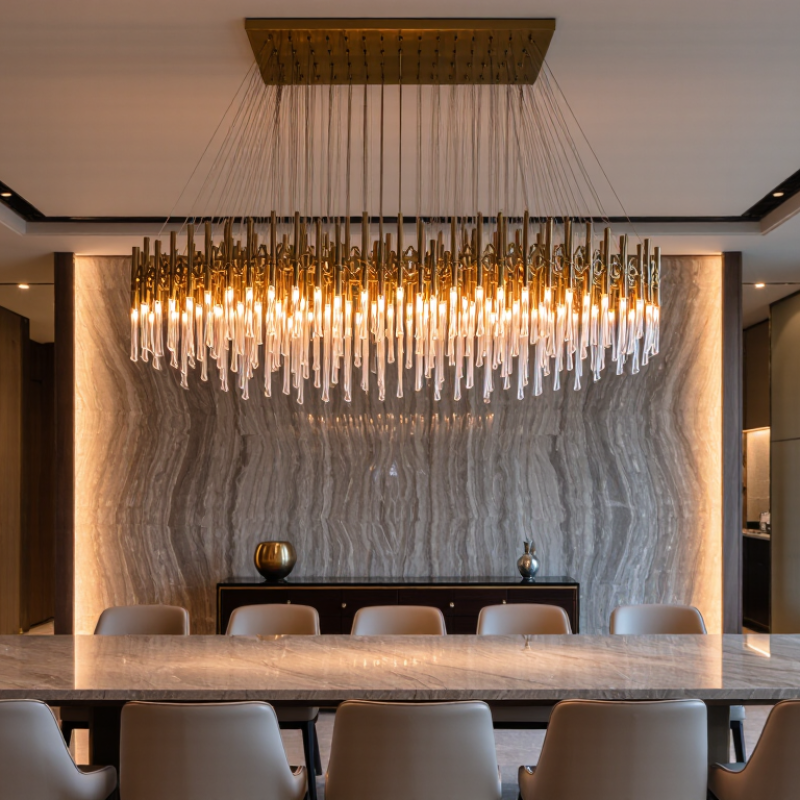
China Top 10 Luxury Bespoke Lighting Trends?
Defining Luxury Bespoke Lighting in the Chinese Market
Luxury bespoke lighting in China means more than a high price. It combines personal design, local culture, technical control, and dependable after-sales support. A hand-finished brass pendant may echo a courtyard gate, while concealed LED layers create a calm evening atmosphere. Popular directions include modular chandeliers, low-glare optics, smart dimming, natural materials, and wellness-focused color temperatures.
Bain & Company’s China Luxury Report 2024 recorded an 18–20% decline in China’s personal luxury market. This change makes meaningful value more important than visual excess. Buyers increasingly examine craftsmanship, lifespan, repair access, and energy performance. The International Energy Agency reports that LED lighting can use at least 75% less energy than incandescent lighting. Still, a beautiful fixture can fail when its driver overheats or replacement parts disappear. That practical gap deserves more attention.
Tips: Specify beam angles, color rendering, dimming compatibility, and maintenance access before choosing finishes. On site, even a small ceiling error can shift a chandelier several centimeters. Request photometric files, material samples, installation drawings, and clear warranty terms. Do not assume every “custom” product is truly bespoke. Ask what can be changed, measured, documented, and repaired.
China’s ten leading luxury bespoke lighting trends are reshaping premium interiors.
The first is sculptural lighting, with oversized pendants treated as room-defining art.
The second favors hand-blown glass and visible craft marks.
The third combines brass, bronze, stone, and timber.
The fourth uses concealed LED sources for quieter ceilings.
Tunable white is the fifth trend, shifting from warm evening light to clearer task lighting.
The sixth introduces circadian programming, although many projects still lack proper commissioning.
The seventh trend is app-free smart control through wall panels and voice systems.
The eighth prioritizes low-carbon materials, repairable parts, and replaceable LED modules.
Grand View Research valued the global smart lighting market at approximately USD 15.2 billion in 2023, with strong growth forecast through 2030.
The ninth trend is modular customization, allowing chandeliers to expand across long dining tables.
The tenth brings regional craft references into contemporary forms, including carved stone, silk textures, and restrained geometric motifs.
Industry practice shows that luxury buyers increasingly expect lighting to feel personal, not merely expensive. The 2024 China Home Consumption Report from Red Star Macalline and the China Household Electrical Appliances Association identifies design quality and intelligent functions as major upgrade drivers. Yet bespoke lighting remains vulnerable to excessive decoration. A beautiful fixture can still produce glare, difficult maintenance, or uneven color. Better projects test light levels on site, document specifications, and leave room for revision.
China Top 10 Luxury Bespoke Lighting Trends
Signature materials now define China’s luxury bespoke lighting market. Grand View Research valued the global decorative lighting market at approximately US$42.9 billion in 2023. This growth supports more experimental residential and hospitality projects. Designers are pairing hand-blown glass with brushed brass, carved stone, lacquered wood, silk, and translucent alabaster. The best fixtures reveal material character, rather than hiding it. Subtle imperfections help.
Craftsmanship is becoming part of the specification. Artisans use lost-wax casting, hand chasing, cloisonné details, wood inlay, and controlled patination. These techniques create shadows that change across the day. A ribbed glass pendant may scatter morning light, then produce sharper reflections at night. Custom proportions also matter. A large entrance fixture needs visual balance, service access, and tested heat management. Beauty alone is insufficient.
Bain’s luxury market research projects Chinese consumers could represent 35–40% of global luxury spending by 2030. Personal meaning will therefore influence bespoke lighting decisions. Clients increasingly request motifs linked to landscape, geometry, or family history. Designers should document material sources, electrical testing, surface finishes, and repair methods. Sustainability reports also encourage longer product lifecycles, but recycled content is not automatically responsible. It may weaken color stability or structural strength. That tension deserves honest review. A memorable fixture should feel handcrafted, technically dependable, and slightly human.
| Rank | Luxury Bespoke Lighting Trend | Signature Materials | Craftsmanship | Artistic Technique | Distinctive Visual Effect | Typical Bespoke Applications |
|---|---|---|---|---|---|---|
| 01 | Hand-Blown Glass Sculptural Pendants | Borosilicate glass Opaline glass Brass | Controlled furnace blowing, shaping, annealing, and hand-polishing | Layered translucency, organic asymmetry, and carefully varied glass thickness | Soft diffusion with individually formed silhouettes and subtle variations in tone | Dining rooms, double-height foyers, luxury villas, and hospitality reception areas |
| 02 | Natural Stone and Alabaster Luminaires | Alabaster Onyx Marble Brass | Water-jet cutting, CNC shaping, hand honing, and edge finishing | Bookmatching, vein alignment, stone translucency, and carved relief | Warm, atmospheric illumination that reveals natural veining and mineral depth | Wall sconces, console lamps, feature pendants, and private club interiors |
| 03 | Patinated Bronze and Sculpted Metal Lighting | Bronze Copper Brass Steel | Lost-wax casting, sand casting, chasing, hammering, and hand patination | Textured surfaces, relief work, controlled oxidation, and sculptural modelling | Deep metallic character with an artisanal surface that changes under different light angles | Statement chandeliers, art-led corridors, libraries, and executive interiors |
| 04 | Architectural LED Ribbon and Linear Systems | Aluminium Optical diffuser Acrylic Silicone | Precision extrusion, concealed heat management, seamless joining, and custom dimming integration | Continuous luminous lines, geometric composition, and indirect light layering | Clean architectural illumination with reduced glare and highly controlled visual rhythm | Feature ceilings, staircases, galleries, hotel corridors, and contemporary residences |
| 05 | Lacquered Wood and Traditional Joinery Fixtures | Walnut Oak Bamboo Natural lacquer | Mortise-and-tenon or concealed joinery, hand sanding, sealing, and layered lacquering | Grain matching, carved screens, perforation, and restrained East Asian composition | Filtered, intimate light combined with tactile warmth and natural material depth | Tea rooms, bedrooms, dining areas, boutique residences, and wellness spaces |
| 06 | Handwoven Textile and Fiber Shades | Silk Linen Rattan Woven reed | Hand weaving, pleating, stitching, basket weaving, and custom frame fitting | Open-weave patterning, layered fabric construction, and natural irregularity | Gentle ambient light with visible texture, shadow pattern, and acoustic softness | Lounges, restaurants, bedrooms, tea spaces, and resort-style interiors |
| 07 | Porcelain and Ceramic Art Lighting | Porcelain Stoneware Ceramic glaze Brass | Wheel throwing, slip casting, kiln firing, glazing, and hand painting | Crackle glaze, celadon-style surfaces, pierced patterns, and sculptural carving | Refined, softly reflective surfaces with a balance of craft detail and diffused light | Bedside lamps, wall lights, display areas, private dining rooms, and galleries |
| 08 | Crystal and Prismatic Optical Installations | Optical crystal Cut glass Stainless steel Brass | Precision cutting, faceting, polishing, drilling, and modular suspension | Prismatic composition, clustered repetition, and controlled refraction | Distinctive highlights, sparkle, and layered reflections that create a jewel-like atmosphere | Grand stairwells, entrance halls, luxury dining rooms, and ceremonial spaces |
| 09 | Hand-Forged Iron and Minimalist Metal Frames | Wrought iron Mild steel Bronze Powder coating | Hot forging, bending, welding, grinding, and hand-applied finish treatment | Linear abstraction, disciplined geometry, and deliberately visible tool marks | Strong architectural outlines with a restrained, gallery-like presence | Modern villas, art collections, corridors, staircases, and commercial lounges |
| 10 | Mixed-Material Artistic Chandeliers | Glass Metal Stone Wood Textile | Multi-material prototyping, concealed structural engineering, hand assembly, and custom balancing | Asymmetrical clustering, narrative composition, and contrast between transparent and solid elements | A one-of-a-kind focal point that combines sculpture, architectural scale, and functional light | Hotel atriums, private collectors’ homes, cultural venues, and high-end dining spaces |
China’s luxury bespoke lighting market is moving beyond decorative excess. Clients increasingly ask how a fixture thinks, saves energy, and belongs to its setting. In project reviews, I often see adaptive dimming, occupancy sensors, and circadian lighting specified together. App control is useful, but physical switches still matter. Technology should feel calm, not demanding.
Sustainability now shapes material selection and construction. Recycled glass, responsibly sourced timber, and low-impact metal finishes are gaining attention. Designers also request replaceable LED modules and accessible drivers. This supports longer service life and easier maintenance. However, “green” claims need evidence. A beautiful fixture is not sustainable if it cannot be repaired. That contradiction deserves more honesty.
Cultural design adds deeper character. Contemporary lantern forms may reinterpret courtyard shadows, carved screens, river stones, or woven textures. Local craft can soften precise digital fabrication. Layered lighting, hidden sources, and sculptural silhouettes create the remaining key directions. Warm color temperatures often support hospitality, while precise beam control protects artwork and materials. Even so, cultural references can become superficial. A copied motif is not cultural understanding. The strongest bespoke work studies proportion, craft, daily rituals, and regional light before shaping the final object.
Scale is equally important. For a long dining table, I usually test the fixture height with temporary mock-ups before approving metalwork or crystal details. In a bedroom, concealed linear lighting can soften stone walls and timber surfaces. Bathrooms require suitable ingress protection, especially near water. The right specification depends on local conditions and installation rules.
Grand View Research has reported strong growth in smart lighting, driven by control systems and connected homes. Yet automation should remain simple. Too many scenes confuse residents.
Material samples should be viewed under the final light source. Brass may appear yellow, while smoked glass can reduce useful brightness. I have misjudged scale before; drawings rarely reveal how heavy a pendant feels above a table. Reports provide direction, not certainty. Luxury customization still needs on-site testing, electrician coordination, maintenance planning, and a realistic replacement strategy. A flawless concept can fail during installation.
It combines personal design, local cultural references, technical control, and dependable after-sales support. Price alone is not enough.
Sculptural pendants, modular chandeliers, concealed LEDs, natural materials, and regional craft details are increasingly requested. Some designs remain too decorative.
Designers may reference courtyard gates, carved stone, silk textures, or restrained geometric patterns. The reference should feel subtle.
They create quieter ceilings and softer visual effects. However, hidden components still need accessible drivers and replacement paths.
Confirm beam angles, color rendering, dimming compatibility, light levels, and maintenance access. Request drawings and photometric files.
LED systems can use far less energy than incandescent lighting. Efficiency still depends on drivers, controls, operating hours, and correct commissioning.
Wall panels, voice systems, tunable white, and scheduled scenes can support different activities. App-free control may feel simpler.
Ask about repair access, replacement parts, warranty terms, and LED module changes. A beautiful fixture can still become inconvenient.
Small ceiling errors can shift a chandelier several centimeters. On-site testing and installation drawings can reduce unpleasant surprises.
No. Ask what can be changed, measured, documented, and repaired. Some “custom” pieces only change surface finishes.
Luxury bespoke lighting in China is evolving from simple illumination into a form of architectural art and personal expression. This article explores what are the trends in luxury bespoke lighting, focusing on designs that combine refined aesthetics, cultural meaning, and tailored functionality. The ten leading trends include sculptural statement pieces, layered lighting schemes, natural materials, handcrafted details, artistic metalwork, translucent surfaces, minimalist forms, and lighting inspired by traditional Chinese patterns and contemporary interiors.
It also examines how skilled craftsmanship, premium finishes, and innovative artistic techniques create distinctive visual experiences for residences, hotels, galleries, and commercial spaces. Smart controls, energy-efficient systems, sustainable materials, and adaptable color temperatures are becoming increasingly important in luxury projects. The article concludes with practical guidance for selecting and customizing lighting according to a space’s size, atmosphere, layout, and purpose, helping clients achieve a balanced result that reflects individual taste while integrating technology, environmental responsibility, and culturally inspired design.

PureRay Light